Trader Growth Path: Three Learning Stages
A beginner-friendly trading learning path focused on survival, stability, deliberate practice, and simplifying the study process.
Trading growth rarely begins with sophistication.
It usually begins with confusion.
A beginner sees a strong move, hears a confident opinion, reads a new framework, and wants to understand everything at once.
That impulse is normal.
But the learning path becomes healthier when the goal changes from:
How do I get certainty quickly?to:
How do I build a process I can review?This playbook describes a simple three-stage growth path:
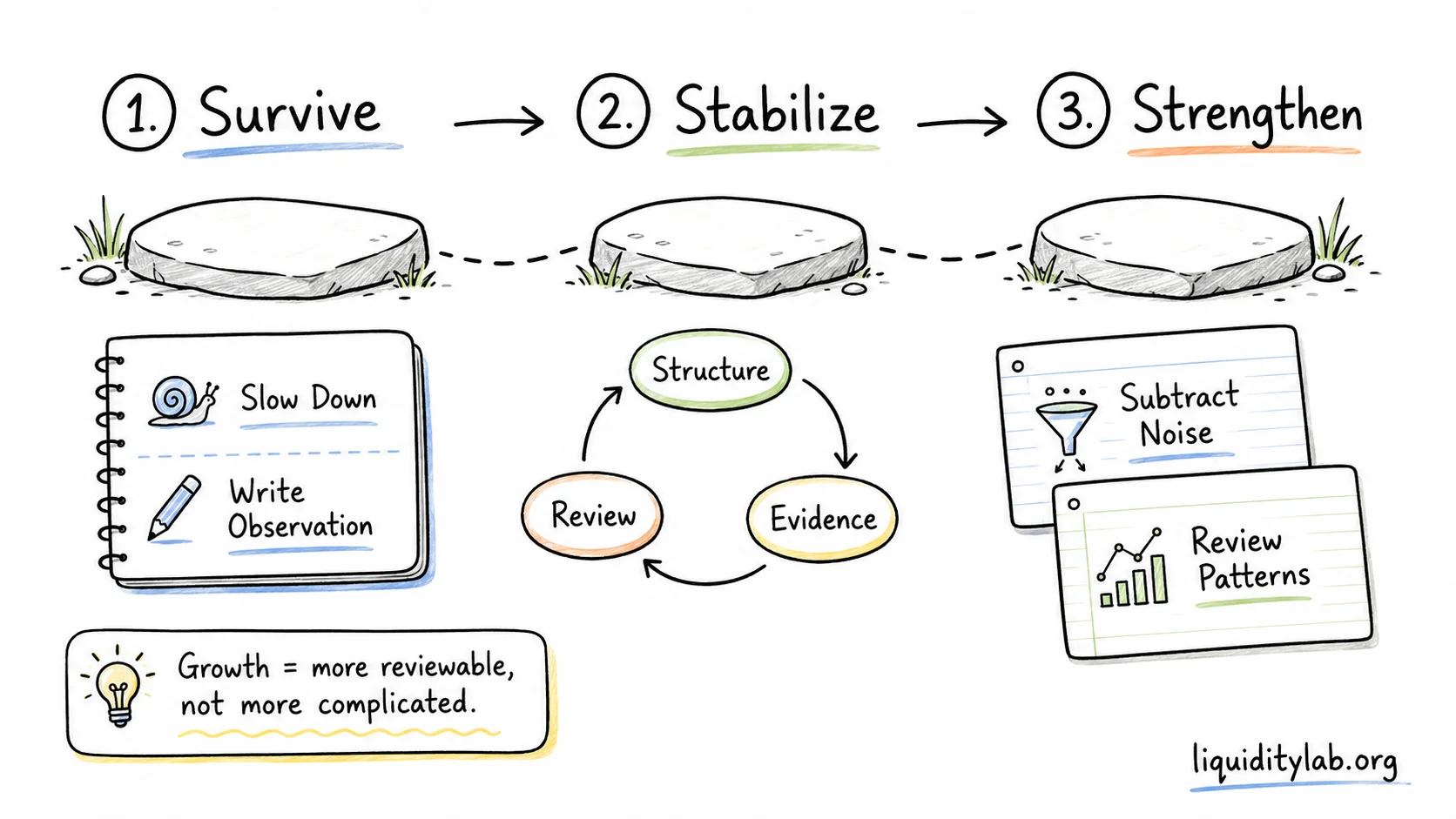
Survive -> Stabilize -> StrengthenEducational content only. This page does not provide trade direction, entries, exits, stop-loss levels, targets, position sizing, leverage, or return expectations.
Stage 1: Survive
The first stage is not about becoming advanced.
It is about avoiding the kind of learning behavior that destroys the learning process itself.
At this stage, common problems include:
- reacting to every candle
- changing frameworks too quickly
- treating one outcome as proof
- asking for certainty
- copying other people's conclusions
- reviewing only when the result feels painful
The beginner often thinks the problem is a missing tool.
But the deeper problem is usually the absence of a repeatable learning loop.
Survival, in this educational sense, means:
slow down,
write the observation,
avoid over-interpreting one result,
and keep enough mental space to review.
Stage 2: Stabilize
The second stage begins when the learner stops chasing every explanation.
Instead of asking every framework to solve every chart, the learner starts building a stable observation sequence.
In LiquidityLab language, that sequence may look like:
Structure -> Liquidity -> Location -> Scenario -> ReviewStability does not mean every observation is correct.
It means the observation is consistent enough to review.
At this stage, the learner improves by making the process visible:
- What did I see first?
- What evidence did I record?
- What was uncertain?
- What would make this reading fail?
- What did I learn after the chart developed?
This is where a learner begins to separate process quality from outcome emotion.
Stage 3: Strengthen
The third stage is not about adding more complexity.
It is about turning repeated review into clearer judgment.
The learner begins to notice:
- which market states are easier to read
- which conditions create confusion
- which framework labels are helpful
- which labels are only decoration
- which emotional patterns distort observation
- which review questions actually improve the next sample
Strength does not mean confidence without doubt.
It means the learner can hold doubt without collapsing into randomness.
The chart is still uncertain.
But the learner's process becomes less chaotic.
The common beginner curve: addition before subtraction
Most learners go through an addition phase.
They collect:
- indicators
- chart patterns
- videos
- terminology
- trading styles
- framework labels
- other people's opinions
This phase can be useful.
It exposes the learner to the map of possible ideas.
But if it continues too long, the chart becomes a crowd of competing voices.
The next phase is subtraction.
The learner starts asking:
Which tools can I actually review?
Which framework language helps my observation?
Which idea only makes me sound more advanced?
Which note can I repeat for the next 20 samples?
This is why depth matters.
Growth usually does not come from knowing a little about everything.
It comes from practicing one small observation deeply enough that mistakes become visible.
A more detailed learning ladder
The three stages can be expanded into a simple ladder.
Use this as a reflection map, not as a ranking system.
1. Early luck
The learner may experience a few good outcomes before understanding the process.
This can create false confidence.
2. First shock
The learner realizes that a few good outcomes do not equal skill.
Emotion becomes harder to manage.
3. Tool collection
The learner starts studying indicators, patterns, frameworks, and terminology.
This is normal, but it can become endless.
4. Confusion from too much information
Different tools give different explanations.
The learner feels less clear than before.
5. A small repeatable method appears
The learner starts using one observation sequence more consistently.
This is often the first real turning point.
6. Subtraction
The learner removes tools and ideas that cannot be reviewed.
Fewer inputs create clearer feedback.
7. Process before label
The learner becomes less dependent on the name of the framework.
What matters more is whether the observation can be written, invalidated, and reviewed.
8. Simplicity becomes useful
The learner no longer mistakes complexity for skill.
Simple notes become more valuable because they can be repeated.
9. Review becomes identity
The learner no longer treats review as punishment.
Review becomes the normal way to keep the process honest.
When studying makes you feel worse
Some learners notice a confusing phase:
Before studying, I felt more decisive.
After studying, I feel slower and less certain.
This does not automatically mean learning is making you worse.
Early in the journey, a learner may act with little fear and little analysis. In a strong market condition, that can occasionally produce good outcomes. Later, as the learner studies more failure modes, risk boundaries, and framework labels, the mind has more information to process.
That can create hesitation.
The healthier interpretation is:
- early luck can feel like skill before the process is visible
- learning can temporarily increase uncertainty because more risks become visible
- stable practice begins when the learner can write a simple observation sequence again
This is part of the move from unconscious action, to over-aware confusion, to reviewable judgment.
The goal is not to return to the old confidence.
The goal is to build a confidence that can survive review.
Deliberate practice converts experience into skill
Experience alone does not guarantee improvement.
Repeating confusion can simply create deeper confusion.
Deliberate practice needs a narrow question.
For example:
For the next 20 samples,
I will only review whether I labeled range conditions too early.
Or:
For the next 10 observations,
I will write Structure / Liquidity / Location before reading outside commentary.
The point is not to make the exercise impressive.
The point is to make it reviewable.
Discipline as attention redirection
Discipline is often misunderstood as forcing yourself to do something painful.
A more useful definition is:
Discipline is the ability to redirect attention back to the learning process.
When the learner feels urgency, fear, regret, or overconfidence, the task is not to delete the emotion.
The task is to return attention to the next reviewable action:
- write one sentence
- mark one structure
- save one original judgment
- compare one later outcome
- identify one misunderstanding
Small actions matter because they restart the loop.
Progress is not linear
Learning often moves in spirals.
You may understand a concept in one market condition and then feel confused again in another.
That does not automatically mean you failed.
It may mean the concept has entered a new context.
The learner grows by applying the same review loop across different conditions, not by expecting one clean breakthrough to solve everything.
Reflection exercise
Write down where you are in the three-stage path:
Survive:
What behavior currently makes learning unstable?

Stabilize:
What observation sequence can I repeat for the next 10 samples?

Strengthen:
What recurring misunderstanding do I want to review more carefully?
Then write one subtraction decision:
For the next two weeks, I will stop using:

So I can focus on:
The point
The growth path is not about becoming fearless.
It is about becoming reviewable.
At first, the learner reacts.
Then the learner records.
Then the learner reviews.
Then the learner simplifies.
That is how a scattered study process becomes a durable one.