Probability Thinking and Market Logic
Learn why trading study should focus on uncertainty, sample review, and repeatable observation instead of prediction.
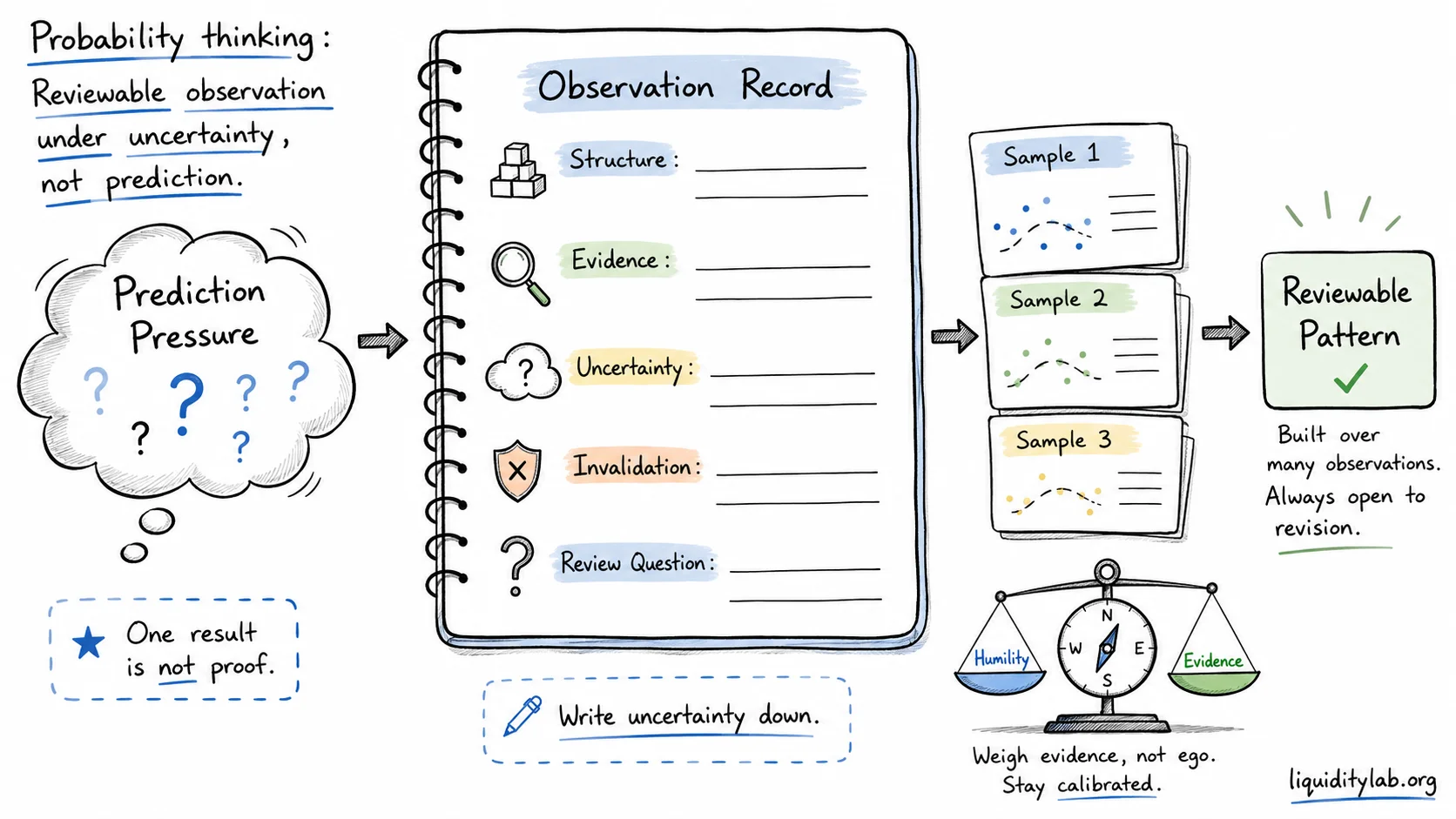
Many beginners enter the market with one hidden question:
How do I know what will happen next?
That question feels natural.
But it also creates pressure.
If the market moves differently from the forecast, the learner feels wrong. If the market moves in the expected direction, the learner feels confirmed. Over time, the study process becomes a loop of guessing, reacting, and defending old opinions.
This playbook offers a different starting point:
Market study is not about certainty. It is about observing uncertainty in a repeatable way.
Educational content only. This page does not provide trade direction, entries, exits, stop-loss levels, targets, position sizing, leverage, or return expectations.
Market logic is not prediction
A market can look random at the level of one candle, one move, or one emotional reaction.
But that does not mean study is useless.
The useful question is not:
Will price go up or down next?The better learning question is:
What kind of market condition am I observing,
and what evidence would make that reading stronger or weaker?
That shift matters.
Prediction tries to remove uncertainty.
Observation tries to work with uncertainty.
Probability thinking begins with humility
Probability thinking does not mean saying "this has a high probability" whenever a chart looks familiar.
It begins with a quieter idea:
Any single observation can fail.
A structure can look clear and still break down.
A range can look balanced and still expand suddenly.
A pullback can look healthy and still turn into a deeper transition.
A framework label can sound precise and still describe only one possible interpretation.
The point is not to become pessimistic.
The point is to stop treating one chart reading as proof.
Five assumptions that make review possible
Use these as study assumptions, not as trading rules.
1. Anything can happen
No analysis removes all uncertainty.
Even a clean structure can fail.
That is why the page uses the word "observation" rather than "prediction".
2. You do not need to know the next move
In learning mode, the goal is not to know the future.
The goal is to describe the current structure clearly enough that the later review has something concrete to compare against.
3. One result does not prove the method
A single correct-looking outcome does not prove that the observation process was good.
A single failed outcome does not prove that the process was useless.
Review needs samples.
4. Edge language should be handled carefully
Words like "edge", "probability", and "setup" can become dangerous when they are used as shortcuts.
For LiquidityLab study, treat them as review concepts:
- What evidence appeared?
- What evidence was missing?
- What was misunderstood?
- What would make this reading fail?
5. Emotional pressure changes observation quality
When the learner wants an answer immediately, the chart often becomes a screen for emotion.
Fear, urgency, regret, and overconfidence can all make the same chart look different.
That is why a written observation is useful.
It slows the mind down before the interpretation changes.
Why "being right" is a weak study goal
"Was I right?" is an easy review question.
But it is often too shallow.
It only compares the chart reading with the final outcome.
A better review asks:
What did I actually observe?
What did I assume?
What did I ignore?
What would have invalidated the reading?
What can be made clearer next time?
This kind of review is less exciting.
It is also more useful.
It turns one chart into a reusable learning sample.
The difference between outcome and process
Two learners can look at the same market and reach different conclusions.
That does not automatically mean one is intelligent and the other is careless.
They may be using different process layers:
- one focuses on visible structure
- one focuses on liquidity
- one focuses on news
- one focuses on an indicator
- one focuses on a framework label
- one focuses on emotional memory from a recent move
The review question is:
Which process produced the interpretation?Without that question, the learner only remembers whether the outcome felt good or bad.
A safer way to use probability language
Avoid writing:
This should work.
This is high probability.
This is the correct direction.
Write something closer to:
Current observation:

Structure:
Liquidity:
Location:

Evidence supporting this reading:

Evidence missing:

Invalidation of this reading:

Review question:
This language does not pretend to remove uncertainty.
It makes uncertainty reviewable.
Why sample size matters
One observation is a story.
Ten observations begin to reveal habits.
Fifty observations can reveal recurring misunderstandings.
The goal is not to collect samples mechanically.
The goal is to notice patterns in your own observation process:
- Do I label transitions too early?
- Do I ignore range conditions?
- Do I confuse framework vocabulary with market evidence?
- Do I change my view after one emotional candle?
- Do I write vague invalidation conditions?
These questions are usually more valuable than asking whether one particular chart was "right".
How this connects to Market Structure OS
Probability thinking needs structure.
Otherwise it becomes a vague feeling.
Market Structure OS gives the learner a repeatable sequence:
Structure -> Liquidity -> Location -> Scenario -> ReviewThe sequence does not promise certainty.
It simply creates a clean container for uncertainty.
Instead of asking the AI or another trader for an answer, you can first write:
Structure:
Liquidity:
Location:
What would make this reading fail:
What I will review later:
That is the beginning of probability thinking in practice.
What to avoid
When studying probability and market logic, avoid turning educational ideas into execution shortcuts.
Avoid:
- treating one example as proof
- using framework terms as confirmation
- replacing written observation with confidence
- chasing a perfect formula
- changing the explanation after the outcome is known
- asking for certainty when the market only offers evidence
The more uncertain the market feels, the more important the review structure becomes.
Reflection exercise
Choose three old chart observations.
For each one, answer:
1. What did I believe was happening?
2. What evidence did I write down?
3. What did I assume but not verify?
4. What would have invalidated the reading?
5. What did the later chart reveal about my observation habit?
Do not score yourself by whether the final outcome matched the first idea.
Score the observation by whether it was clear enough to review.
The point
Probability thinking is not a way to sound more professional.
It is a way to stay honest.
It reminds you that the market does not owe you certainty, and that learning improves when uncertainty is written down instead of hidden behind confidence.
The beginner's question is:
What will happen next?The stronger learning question is:
What am I observing, what am I assuming, and how will I review it later?