Independent Thinking and Judgment Boundary
Learn how to use outside opinions without outsourcing your market reading, with a simple boundary playbook for observation, invalidation, and review.
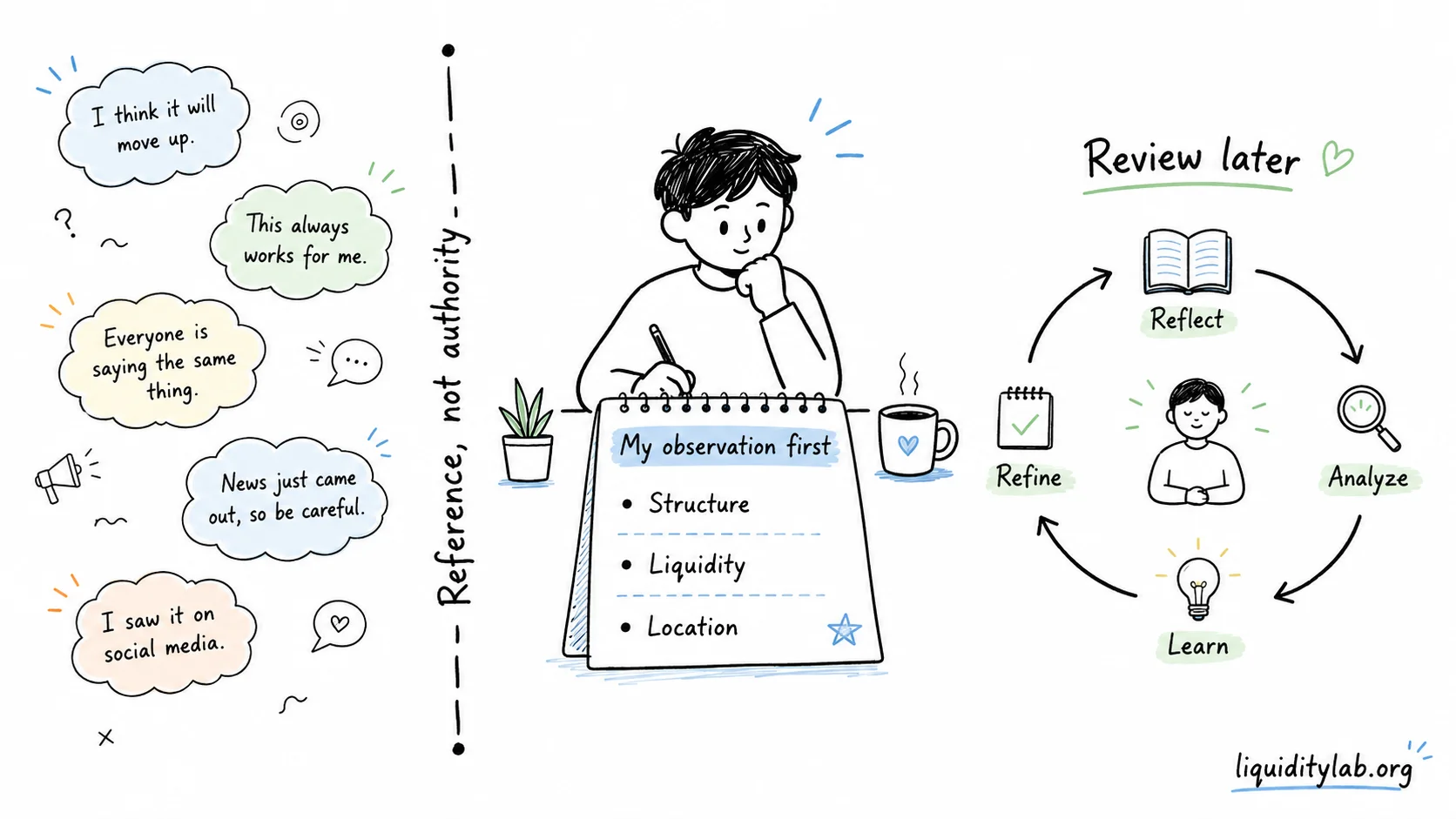
Outside opinions can be useful.
They can also quietly replace your own observation process.
This playbook is about the boundary between:
- using another view as a reference
- letting another view become your decision system
It belongs to the behavior-training layer of LiquidityLab. The goal is not to decide who is right. The goal is to keep your own market reading reviewable.
Educational content only. This page does not provide trade direction, entries, exits, stop-loss levels, targets, position sizing, or return expectations.
The common problem
A learner studies a chart, forms an initial view, then sees someone else's analysis.
The outside view sounds confident.
The learner drops the original observation and waits for the other person to be right.
Later, the outside view changes because the market structure changed.
Now the learner has neither a clean original record nor a useful review.
This is not a problem with one teacher, analyst, or community. It is a normal learning risk whenever judgment is outsourced.
Opinions are snapshots, not instructions
Most market opinions are based on the structure visible at the moment they were made.
When price changes, the structure can change.
That means an opinion can become outdated without anyone being dishonest.
For study, this matters more than whether the opinion was "right."
The useful question is:
What structure did that opinion see, and did my own record capture the same evidence?
The boundary rule
Before reading an outside view, write your own three-line observation:
Structure: What is the visible market state?
Liquidity: Which highs, lows, or zones matter?
Location: Where is price relative to those areas?
Then add one invalidation sentence:
This reading becomes weaker if...Only after that should you read someone else's view.
This one habit protects the review process. It gives you something concrete to compare later instead of remembering only the final result.
How to use outside opinions safely
Use outside views as observation material, not as authority.
Ask:
- What did this view notice that I missed?
- Which timeframe or structure level is it using?
- Is it describing current evidence or projecting a future outcome?
- Does it depend on conditions that have not happened yet?
- If I disagree, can I explain why using visible structure?
The purpose is not to argue with the opinion. The purpose is to understand what kind of evidence it is using.
Separate information from interpretation
Market information rarely arrives as neutral data.
A headline, a post, a screenshot, or a confident thread may combine facts, interpretation, emotion, and persuasion in one package. The learner's job is not to reject everything. The job is to slow the package down.
Before letting any outside information change your market read, ask four questions:
- Who is the source? Is this a teacher, analyst, media account, trader, exchange, fund, or anonymous post?
- What might the source want me to feel? Urgency, fear, confidence, regret, or a sense that I am late?
- Which part is fact, and which part is interpretation? A price level, timestamp, or published statement is not the same as a forecast.
- Would my original structure record change if I had not seen this information? If not, the information may be context, not evidence.
This filter keeps information useful without letting it become a hidden instruction.
For LiquidityLab practice, outside information should enter the review process only after it can be rewritten into visible structure, liquidity, location, evidence, or invalidation.
When your system feels out of sync
Every observation system has periods when it feels unclear.
That does not automatically mean the system is broken.
It may mean:
- the market is ranging while your process expects trend continuation
- the timeframe you are watching is too noisy
- the structure is transitional rather than clean
- your invalidation rules are too vague
- you are asking for certainty where the chart only offers conditions
During these periods, the safest training behavior is usually not to hunt for more signals.
Instead, collect better samples:
- How often was the first reading invalidated?
- Was the mistake structural, procedural, or emotional?
- Did you change your view because the chart changed, or because someone sounded confident?
- Did you record enough evidence to review later?
A simple review exercise
Choose one chart observation and one outside opinion.
Write:
- My original structure reading
- What the outside opinion emphasized
- What price later did
- What my original record missed
- What I should record more clearly next time
This is review, not debate.
If your record was wrong but reviewable, it still helped you train.
If you were right but cannot explain why, the sample is less useful.
What independent thinking is not
Independent thinking is not rejecting every outside view.
It is not trying to be contrarian.
It is not pretending you never need teachers, examples, or frameworks.
Independent thinking means:
- you know what you saw before you asked for help
- you can separate evidence from interpretation
- you can change your view when structure changes
- you can review your own process without needing someone else to validate it
Use this with the AI Workbench
The same boundary applies when using AI.
Before asking the AI assistant for structure, simulation, or framework mapping, write your own observation first.
Then use AI to:
- organize the observation
- identify missing structure details
- turn a vague view into reviewable conditions
- compare framework language without treating it as confirmation
- create better review questions
Do not use AI to replace the first observation.
If you need a workflow, start with the AI Structure Workbench Beginner Manual, then review the record with the Trading Review Method.
Weekly practice
For one week, do this once per day:
- Write your own three-line observation.
- Add one invalidation sentence.
- Read one outside view only after your record is written.
- Mark what the outside view added, corrected, or over-assumed.
- Review the original record after price develops.
At the end of the week, ask:
- Did I change my view because structure changed?
- Did I change my view because someone sounded confident?
- Which part of my observation was too vague?
- What should I write more clearly next week?
The goal is not to be isolated.
The goal is to become easier to review.
Educational content only. Not financial advice.