Depth Over Breadth in Trading Study
Learn why focused practice, sample collection, and repeated review often beat shallow tool-hopping in trading education.
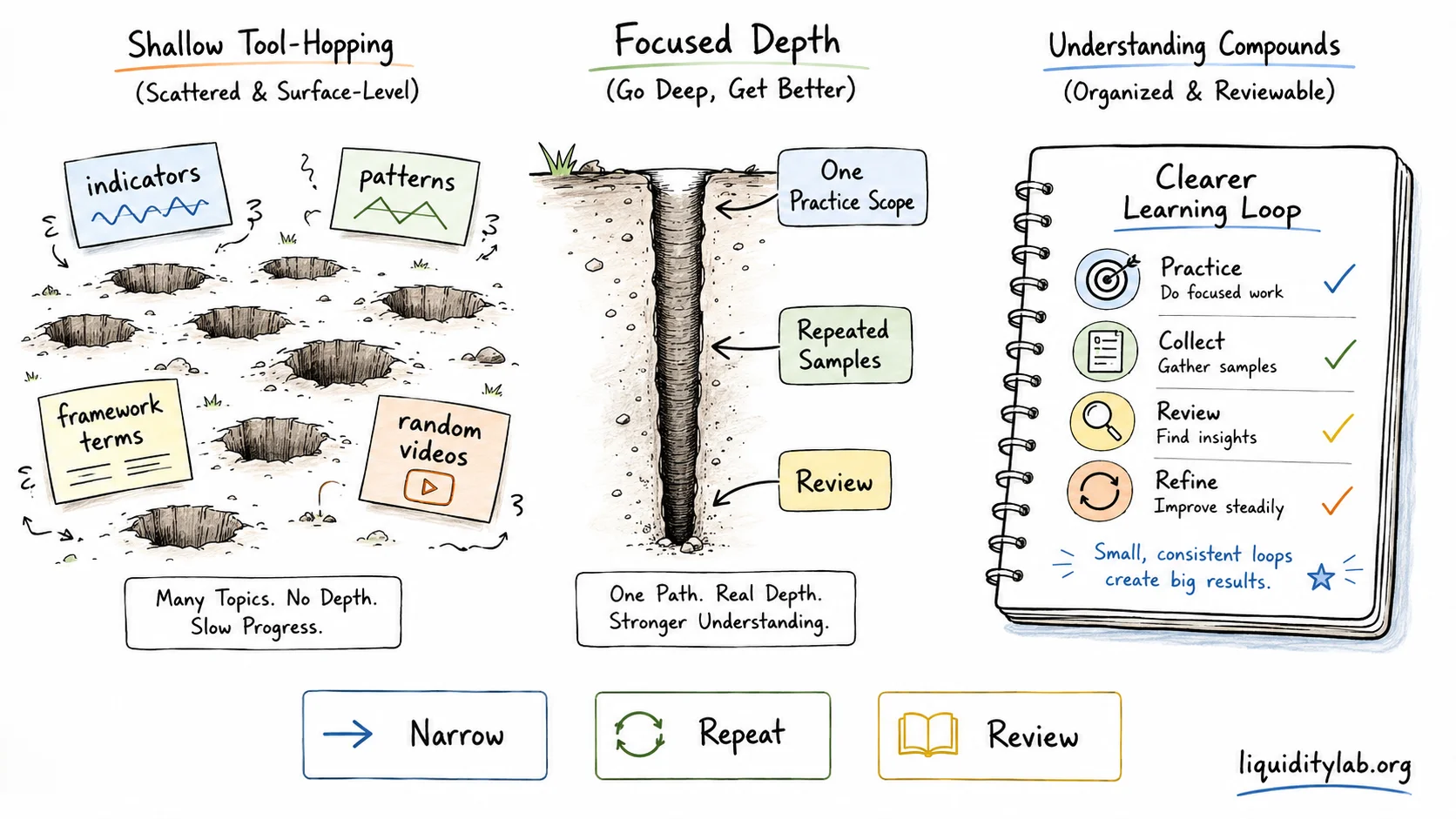
Trading learners often think the next tool will solve the confusion.
One indicator feels useful, then another framework looks more advanced, then a new model appears, then a different trader explains the market in a different language.
Soon the chart is covered with tools.
But the reading is not clearer.
This playbook is about a simple learning principle:
Study narrow enough to repeat. Practice deep enough to review.
Educational content only. This page does not provide trade direction, entries, exits, stop-loss levels, targets, position sizing, leverage, or return expectations.
Why more tools can make the chart harder to read
More knowledge is not always the problem.
Unorganized knowledge is.
Every tool has its own language:
- indicators
- candlestick patterns
- price action
- SMC / ICT vocabulary
- Wyckoff phases
- Elliott Wave counts
- harmonic ratios
- Chan Theory structure labels
Each language may be useful in the right place.
But if you apply too many at once, they start competing for attention.
One tool says the move is strong.
Another says the range is unclear.
Another says the structure is still incomplete.
The learner does not need another label.
The learner needs a smaller practice field.
What depth over breadth means
Depth over breadth does not mean you can never learn new frameworks.
It means you should not ask every framework to judge every chart at the same time.
For a training period, choose a small scope:
- one market state
- one structure type
- one observation template
- one review question
- one framework language, if needed
Then repeat it enough times that patterns become visible.
Depth is not about worshiping one tool.
Depth is about collecting enough reviewable samples to understand how your observation actually behaves.
A narrower scope creates better review
If you study five different tools this week, and one chart confuses you, it is hard to know what failed.
Was the problem:
- the tool?
- the timeframe?
- the market state?
- the way you marked levels?
- the way you changed your view?
- the emotion you felt after the first move?
When the scope is smaller, review becomes cleaner.
Example:
For two weeks, I will only collect range-boundary observations.
Each sample must include:
Structure:
Liquidity:
Location:
Invalidation:
Review question:
Now you are not trying to master the whole market.
You are training one observation muscle.
The common learning path
Many learners go through this path:
Collect everything
-> feel overloaded
-> remove what cannot be reviewed
-> practice one small structure
-> rebuild with clearer rules
The overload stage is normal.
It does not mean you are bad at learning.
It means the system has too many inputs and too few review loops.
The turning point is not adding one more tool.
The turning point is choosing what to stop using for a while.
Subtraction protects the practice loop
Doing less is not a sign that the learner is less serious.
It is often the condition that makes serious practice possible.
When a learner tries to hold every tool, every framework, and every possible opportunity at the same time, attention becomes too crowded to review. The problem is not effort. The problem is that the practice field has no boundary.
For one training block, subtraction means:
- choosing one or two structures to study deeply
- pausing tools that are not part of the current question
- refusing to switch methods after one confusing example
- letting missed examples stay missed if they do not fit the practice scope
The goal is not to become narrow forever.
The goal is to make one learning loop clear enough that improvement can actually be seen.
Choose a practice structure
A good practice structure is not necessarily the most impressive-looking one.
For study, choose something you can recognize and review.
Examples:
- range boundary reaction
- pullback inside a trend
- failed breakout at a key level
- transition from trend to range
- liquidity sweep followed by rejection
- one candlestick reaction at a known level
The structure should be narrow enough that you can collect repeated samples.
The question is:
Can I find ten examples and review them with the same template?
If the answer is no, the scope may still be too wide.
What to pause temporarily
Depth requires saying no for a while.
You may pause:
- new indicators
- new framework videos
- new chart templates
- new terminology lists
- arguments about which framework is superior
- switching methods after one confusing example
This does not mean those things are useless.
It means they are not part of the current practice block.
Your study system needs boundaries just like a chart observation needs boundaries.
Protect the focus block
Depth needs time.
Not all day.
Just enough uninterrupted time to complete one loop:
Select sample
-> write observation
-> mark invalidation
-> save record
-> review later
This is why depth over breadth connects directly to Trading Study Time Management.
If your learning is only done in fragmented moments, you may collect information, but you may not build depth.
Use spare time for light input.
Use protected blocks for deep practice.
Use AI without widening the scope
AI can accidentally make breadth worse.
If you ask broad questions, it can give you more concepts, more labels, and more possible interpretations.
Use AI to keep the scope small:
- "Help me review only this range-boundary observation."
- "Do not add new frameworks. Organize my Structure, Liquidity, and Location notes."
- "Turn this observation into one review question."
- "List what would invalidate this reading without giving trade advice."
- "Help me compare these ten samples for repeated mistakes."
Good AI use narrows attention.
It does not flood the learner with more language.
A two-week depth practice
Choose one practice structure.
For two weeks:
- Collect ten examples.
- Use the same observation template each time.
- Write one invalidation condition for every sample.
- Do not add a second framework during the sample period.
- Review the samples as a group.
At the end, ask:
- Which part became easier to see?
- Which part stayed vague?
- Did I change the template too often?
- Did I confuse framework labels with structure?
- Did a smaller scope make review clearer?
The goal is not to prove that one tool is best.
The goal is to make one learning loop deep enough to improve.
When to expand again
You can expand after the small loop becomes reviewable.
Signs that expansion may be reasonable:
- you can explain the structure without needing many labels
- your records are consistent enough to compare
- you know what invalidates the observation
- your review identifies repeated mistakes
- a new tool answers a specific question instead of adding general excitement
Expansion should solve a problem.
It should not be a way to escape boredom.
Reflection exercise
Write down every trading tool, framework, indicator, or model you are currently studying.
Then choose one small practice scope for the next two weeks.
Write:
For the next two weeks, I will collect examples of:
I will not add:
Each sample must include:
The review question will be:
Keep the scope almost uncomfortably small.
That is the point.
Depth starts when the learning field becomes narrow enough to repeat.
Educational content only. Not financial advice.