AI Structure Workbench Beginner Manual
Learn how to use the LiquidityLab AI Structure Workbench for observation records, Plan Cards, scenario thinking, and review.
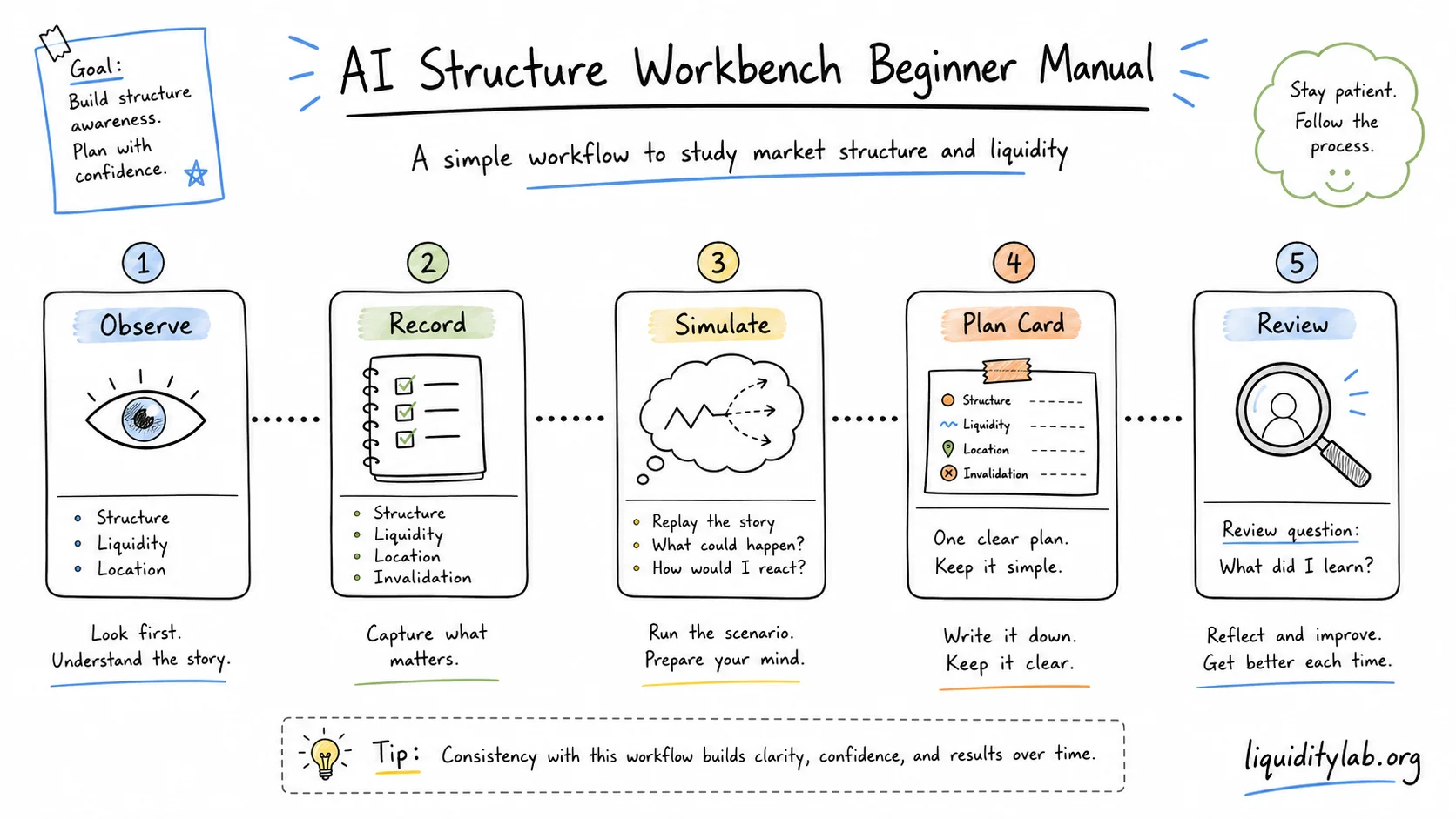
The AI Structure Workbench is not a tool that tells you whether to buy or sell.
It is a pause system.
Before you ask AI what the market means, the workbench asks you to write down what you can actually observe. That small delay is the point.
If you want the full study-system map before using the workbench, start with LiquidityLab Market Structure OS.
Start with one rule
Write observations first.
Ask AI second.
The workbench is designed around this sequence:
Observe -> Record -> Simulate -> Plan Card -> ReviewIt helps you turn quick reactions into records that can be reviewed later.
Where to open it
Open the AI page, then choose the Structure Workbench tab.
If you only want to ask definitions, terms, or course questions, use the simple Q&A mode.
If you are looking at a chart and want to train your observation process, use the Structure Workbench.
Quick mode chooser
Use this table when you are not sure which mode fits your question.
| If you want to... | Use | Safe request |
|---|---|---|
| Ask what a term means | Simple Q&A / Knowledge Base | "Explain BOS in beginner language and cite English docs." |
| Organize chart observations | Structure Engine | "Use my record to describe market state, visible structure, uncertainty, and invalidation." |
| Practice multiple paths | Simulation Engine | "List long-side, short-side, and wait paths as observation scenarios only." |
| Rewrite target-like language | Projection Hypothesis | "Rewrite this measured move as reference zones and scenario checkpoints, not a target." |
| Compare frameworks | Framework Mapping | "Translate the same structure into SMC, Wyckoff, and Chan language without signals." |
| Build a reviewable drill | Execution Training | "Turn this record into a simulated drill with no entry, stop, target, or sizing." |
| Save a review note | Plan Card | "Fill the Plan Card as an observation record, not a trading plan." |
| Learn from what happened | Review | "Help me compare my original observation with what price actually did." |
The three-sentence record
The three-sentence record is the entry point.
It has three fields:
Structure
Describe the current market structure.
Good examples:
- Price is still inside a range.
- The higher structure is still trending, but the lower structure is pulling back.
- Price broke a prior low, but reversal is not confirmed.
- Price moved sharply lower and is now consolidating.
Avoid:
- I should buy here.
- This must reverse.
- It is definitely going up.
Liquidity
Describe visible highs, lows, equal highs, equal lows, range boundaries, or obvious areas where orders may cluster.
Good examples:
- There is a prior high above price.
- There is a clear low below price that has not been broken.
- Both sides of the range are clear, but the middle is noisy.
- Price swept a lower low but did not continue immediately.
Avoid:
- Liquidity is here, so price must reverse.
- The sweep means the next move is guaranteed.
- Smart money must push price up.
Location
Describe where price is located.
Good examples:
- Price is near the upper side of the range.
- Price is in the middle of a prior selloff.
- Price is near a prior low.
- Price is close to the latest structure-break area.
Avoid:
- This is the best entry.
- The stop is small here.
- The reward-to-risk is perfect.
The workbench modes
The workbench modes are not separate trading systems. They are different ways to organize your thinking.
Knowledge Base
Use this for concepts and terminology.
Example questions:
- What is CHoCH?
- What is the difference between BOS and MSS?
- What is the difference between a liquidity sweep and a false breakout?
Structure Engine
Use this when you want AI to organize the current observation into market-state language.
Example questions:
- Based on my three-sentence record, does this look more like trend, pullback, range, or transition?
- What information is still missing from my observation?
- Which parts of my record are too vague?
Simulation Engine
Use this to practice scenario thinking.
Example questions:
- If price moves up, down, or continues sideways, what should I observe in each case?
- List long-side, short-side, and wait paths as observation scenarios only.
- What would invalidate my current reading?
Simulation is not prediction. Its purpose is to help you stop staring at only one path.
Projection Hypothesis
Use this when a measured move, extension, or pattern-completion idea starts to sound like a price target.
Example requests:
- Rewrite this 1:1 measured-move idea as an observation hypothesis.
- Turn this extension idea into approach / reject / overshoot / ignore branches.
- Help me describe this harmonic completion area without calling it an entry or target.
Projection Hypothesis is not a target tool. It turns projection language into reference areas, scenario checkpoints, invalidation, no-action rules, and review questions.
For the full boundary, see Projection Hypothesis and Scenario Checkpoints.
Framework Mapping
Use this when you want the same structure translated into different framework languages.
Example questions:
- Translate this structure into SMC, ICT, and Wyckoff language without giving trade signals.
- How would SMC describe the same price behavior?
- How would a price-action reader describe this differently?
Framework mapping is translation, not voting.
Execution Training
Use this when you want to turn an existing record into a simulated drill.
Example requests:
- Turn this record into an execution-training drill.
- Help me check whether my Plan Card is reviewable.
- Rewrite this into observation conditions, invalidation, a no-action rule, and review questions.
Execution Training is not a live order-management assistant. It does not tell you where to enter, where to place a stop, where to take profit, how to size, or how to manage an open position.
For the full boundary, see Execution Training and Plan Layer.
Copy-safe prompts
Use these prompts when you want the AI to stay inside the workbench boundary.
Structure Engine prompt
Based on my three-sentence record, organize the answer into Market State, Visible Structure, Liquidity / Observation Zones, Evidence vs Uncertainty, and Invalidation. Do not give entries, stops, targets, sizing, or trade direction.Simulation Engine prompt
List Long-side, Short-side, and Wait / No-action paths as observation scenarios only. For each path, include observation conditions, risk points, invalidation points, and best observation behavior. Do not choose the best trade.Projection Hypothesis prompt
Rewrite this measured move or extension idea as a projection hypothesis. Use reference zones, scenario branches, invalidation, no-action rules, and review questions. Do not output a target, take-profit level, or probability promise.Framework Mapping prompt
Translate the same neutral structure into SMC, Wyckoff, and Chan Theory language. Start with a unified structure summary first. Do not treat framework agreement as confirmation.Execution Training prompt
Turn this record into a simulated execution-training drill. Include training goal, mock scenario, Plan Card summary, observation tasks, allowed learning states, boundary statement, review questions, and failure patterns. Do not make it an executable trading plan.Review prompt
Help me review this record by comparing Original Judgment, What Price Actually Did, What Was Misunderstood, and What To Correct Next Time. Focus on observation quality, not profit or loss.These prompts do not replace your own record. They only help you ask the AI for structure after you have written what you observed.
Common beginner questions
Why does the AI refuse trade advice?
Because the workbench is built for study, not personal trading decisions.
It can help you organize observations, rewrite risky language, create reviewable records, and compare framework vocabulary. It should not tell you whether to buy or sell, where to enter, where to place a stop, where to take profit, how much size to use, or how to manage a live position.
If the AI refuses a question, rewrite the question as a learning task:
Help me turn this into an observation question instead of a trade decision.Should I use Simple Q&A or Structure Workbench?
Use Simple Q&A when you want definitions, course explanations, or site citations.
Use Structure Workbench when you already have an observation record and want help organizing it into structure, scenarios, framework language, a Plan Card, or a review note.
Simple Q&A starts from a question.
Structure Workbench starts from your record.
What is the difference between Structure Engine and Simulation Engine?
Structure Engine organizes the current observation.
It asks:
- What is the market state?
- What structure is visible?
- What is uncertain?
- What would invalidate this reading?
Simulation Engine organizes possible paths.
It asks:
- What should I observe if price moves higher?
- What should I observe if price moves lower?
- What should I observe if price does nothing clear?
Structure Engine describes the current map. Simulation Engine practices not being trapped by one path.
What is the difference between Projection Hypothesis and Plan Card?
Projection Hypothesis rewrites target-like ideas before they become trade instructions.
Use it when you have language such as:
- measured move
- extension
- completion zone
- projection
- PRZ
Plan Card records the observation after the scenario has been cleaned up.
Projection Hypothesis turns target language into reference zones and checkpoints. Plan Card turns the cleaned-up scenario into a reviewable note.
Does Framework Mapping confirm a trade if several systems agree?
No.
Framework Mapping is translation, not voting.
SMC, Wyckoff, Chan Theory, Elliott Wave, and price-action language may describe the same structure differently. Agreement between labels does not mean the market has confirmed a direction.
Always write the neutral structure first. Then use framework language as a reference layer.
Is Execution Training the same as order management?
No.
Execution Training is a simulated drill layer.
It may help you practice:
- whether a record is reviewable
- whether a Plan Card contains unsafe fields
- whether conditions and invalidation are clear
- whether a scenario has a no-action rule
It should not manage a live order, move a stop, choose an exit, adjust size, or tell you what to do with an open position.
What should I do when the AI says it needs more information?
Add observable information, not a stronger opinion.
Useful additions:
- the visible market state
- the nearest clear high or low
- whether price is near a boundary or in the middle
- what has actually broken
- what is still uncertain
- what would make your reading invalid
Avoid adding:
- "I think it should go up"
- "I want to trade this"
- "The setup looks strong"
- "Tell me the best move"
When should I save a record?
Save a record when it can be reviewed later.
A useful saved record usually has:
- three-sentence observation
- market state
- primary scenario
- conditions
- invalidation
- no-action rule
- review question
Do not wait until you know the outcome. The point is to preserve what you believed before the chart developed further.
When should the English AI index be rebuilt?
Rebuild the English AI index after English content changes under content-en/**.
Examples:
- a new English page is published
- an English page gets a new section
- an English FAQ, prompt pack, or safety boundary changes
- English RAG/search content is corrected
Documentation-only changes under docs/publishing/** usually do not require an AI index rebuild.
Plan Card
A Plan Card is not a trading plan.
It is a structured observation note.
Use it to record:
- Market State
- Primary Scenario
- Conditions
- Invalidation
- No-action Rule
- Review Question
Market State
Use one of these labels:
- Trend
- Pullback
- Range
- Transition
If you are not sure, write that uncertainty directly.
Primary Scenario
This is the path you are mainly observing.
- Long-side path means you are observing the upward scenario.
- Short-side path means you are observing the downward scenario.
- Wait / No-action path means the main task is to observe.
These are observation labels, not trade directions.
Conditions
Write what would make the scenario worth continuing to observe.
Example:
Price approaches a range boundary and shows a clear reaction instead of drifting in the middle of the range.
Invalidation
Write what would make the current reading no longer useful.
Example:
If price returns to the middle of the range and both boundaries become unclear, the boundary-reading hypothesis is invalid.
Invalidation is not failure. It is how you create samples.
No-action Rule
Write when you will not interpret direction.
Example:
If price stays in the middle of the range, I only record observations and do not explain direction.
Review Question
Write the question you want to answer later.
Example:
Did I assume a breakout before price actually held outside the range?
Four-step review
After price develops, use the four-step review.
Original judgment
What did you think at the time?
What price actually did
What happened later?
What was misunderstood
Which part of your original reading was incomplete?
What to correct next time
What should be improved in the next record?
The goal is not to prove you were right or wrong. The goal is to improve your observation process.
A seven-day beginner routine
Day 1: Only fill the three-sentence record.
Day 2: Save one record.
Day 3: Use Structure Engine only.
Day 4: Use Simulation Engine and list at least three paths.
Day 5: If measured-move language appears, rewrite it as a Projection Hypothesis.
Day 6: Generate or write a Plan Card.
Day 7: Check whether your invalidation rule is specific, then review one saved record after price develops.
Questions to avoid
Avoid asking:
- Can I buy now?
- Should I go long or short?
- Where should the stop go?
- What is the target?
- How much size should I use?
- What is the win rate?
Better questions:
- What information is missing from my observation?
- What would invalidate this reading?
- What should I review later?
- How can I rewrite this as an observation instead of a trade idea?
The minimum useful habit
If you only do one thing, do this:
Before asking AI, write Structure, Liquidity, and Location.
That one pause is already a training effect.
Then return to the LiquidityLab Market Structure OS to see how observation records connect to Simulation, Plan Cards, and Review.
If measured moves or proportional extensions are pulling you toward target language, use Projection Hypothesis and Scenario Checkpoints.
If you want to practice simulated execution-adjacent drills safely, continue with Execution Training and Plan Layer.
Educational content only. Not financial advice.